
Here is a recipe of sai ua that I found online:
Sai Ua Moo
(Note: moo or mu means pork in Lao, so sai ua mo means pork sausage - ML)
Ingredients:
Directions:
Place in a bowl the pounded ingredients, the minced pork, the minced pork fat and the chopped coriander leaves. Add the fish sauce and mix all together. Take a very small sample portion of the mixture, wrap it in pieces of banana leaf and grill it until cooked. Taste it and check the saltiness. (If this test is satisfactory you can proceed to make the sausages. If the taste of the grilled sample is not right, adjust the seasoning.)
Stuff a section of the pig's intestine with the mixture from the bowl, taking care not to include any air bubbles. If there are any, use a needle to let them escape.
Tie the intestine into portions as you stuff it, each portion to be 15 cm long. There should be two knots between each section with a space in between for cutting them apart. Use a bamboo holder to grill them until they are done. Then transfer them to a platter.
Serve with Jaew Bong.
Sai Ua Moo
(Note: moo or mu means pork in Lao, so sai ua mo means pork sausage - ML)
Ingredients:
- 400 grams pork meat, including some fat, washed and minced 150 grams pork fat, washed and minced
- 2 dried chilli peppers, soaked in water until soft
- 10 (small) shallots
- 10 black peppercorns
- pound the above three ingredients together finely
- coriander leaves, finely chopped (Note: I was right! it does have coriander. :) - ML)
- Salt and fish sauce
- 1 pig's intestine, turned inside out and washed and then turned right side out again
Directions:
Place in a bowl the pounded ingredients, the minced pork, the minced pork fat and the chopped coriander leaves. Add the fish sauce and mix all together. Take a very small sample portion of the mixture, wrap it in pieces of banana leaf and grill it until cooked. Taste it and check the saltiness. (If this test is satisfactory you can proceed to make the sausages. If the taste of the grilled sample is not right, adjust the seasoning.)
Stuff a section of the pig's intestine with the mixture from the bowl, taking care not to include any air bubbles. If there are any, use a needle to let them escape.
Tie the intestine into portions as you stuff it, each portion to be 15 cm long. There should be two knots between each section with a space in between for cutting them apart. Use a bamboo holder to grill them until they are done. Then transfer them to a platter.
Serve with Jaew Bong.
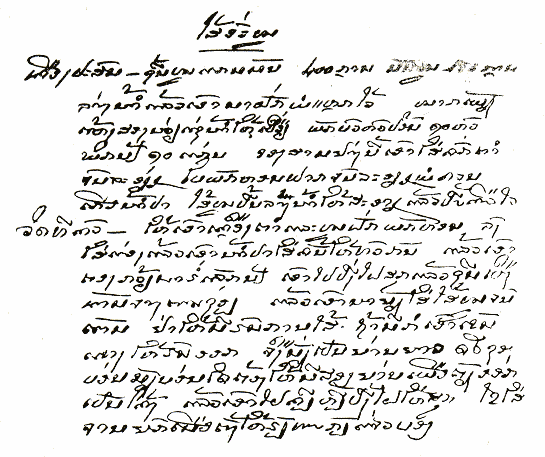
For those who can read it in script, here is the recipe:
Credit: The recipe and photo or recipe written in script is from http://www.seasite.niu.edu/lao/othertopics/foods/recipe12.htm. Many thanks for sharing the recipe with the world! :)


