Monday, August 22, 2011

The difference between longganisa/longaniza and chorizo

While the difference between the has been discussed and contested by some, here are insights lifted from www.asturianus.org's longaniza thread:


In my family, the difference between longaniza and chorizo was always that the first was made as one continuous link and the second as individual links of about about 5 or 6 inches each.I would treat the longaniza as chorizos. I you want the smokey flaor and can't actually smoke it, you could always pour a little smoke flavoring over it an hour or two before cooking. I have done this with commercially available Portuguese linguica with fairly good results. It's not the same as home-made Asturian style chorizos, but it's certainly a move in the right direction. 
- Bob
From http://www.asturianus.org/forum/viewtopic.php?t=227

Longaniza was a favorite sausage of the Spanish people of Spelter. Several families had small out buildings in their yards to "age" their Longaniza. I don't remember anyone eating chorizo, and if they did they probably called it Longaniza. Longaniza that I remember as a kid in the 1950's was in lengths of about 12 inches, or longer.I remember our neighbor Lourdes Lorenzo Menendez (Sergio Menendez' wife) making Longaniza, and storing in her outbuilding for curing. Mildred Alvarez, as I understand it, still makes Longaniza. She is located in Spelter on Route 19 at the foot of the Spelter bridge.My grandfather, Joe "Mike" Alvarez sold the sausage in his store in Spelter, when it was available.Good eating. 
- Ken MenendezFrom http://www.asturianus.org/forum/viewtopic.php?t=227


So based on Ken's definition, simply put, longganisa is longer than chorizo. Cebu's round-like longganisa would qualify as chorizo, while Laoag's long tube of grounded meat would be longganisa.

Do you have insights on the difference between the two? Share it here!

Sunday, August 21, 2011

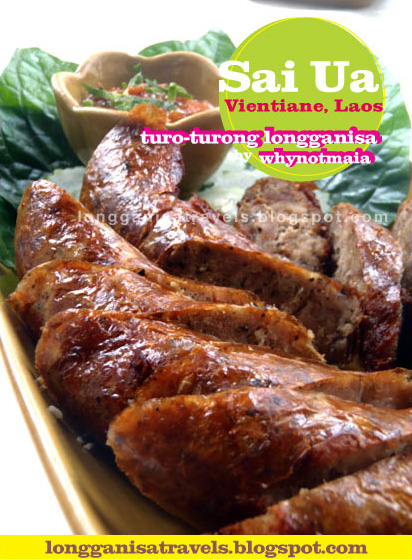
Sai ua: Another variety from Kualao Restaurant in Vientiane, Laos

When it comes to food, it is reasonable to expect varieties not only form different towns or regions but also within the region.

Take sai ua, the sausage from Laos and the Isan region of Thailand.

Along the streets of Vientiane (also spelled as Vieng Chan), vendors selling grilled sai ua are a plenty. A favorite of mine is the stall in front of an abandoned building along Fa Ngum Road, facing the Mekong River. But today, we explored another dining option in Vientiane by the name of Kualao Restaurant, one of the fancy restaurants located along Samsetthirath Road.

Kualao Restaurant is popular for its regular traditional Lao dance performances. Every night, talented locals donning traditional suits take the stage to present its dances to willing audience, which is followed by a hearty Lao dinner. That said, I am expecting the food to be remarkable. As I have never watched the show, I thought we could at least sample the food.

So off for lunch we went to the uncrowded Kualao Restaurant. Food was prepared only after ordering, except for Mok, a traditional Lao food wrapped and steamed or boiled in banana and pandan leaves which takes an entire day to prepare. Naturally I ordered the pork sausage:

Name/Type: Sai ua/sai uwa (listed as Pork Sausage in their menu)
Meat used in the sausage: Pork
Price: 59,000 Kip (LAK) or US$7.34


From Kualao Restaurant
141 Samsenthai Road, Vientiane. Tel & Fax: (856-21) 215 777


While this is also a sample of sai ua, it's tastes and texture is noticeably different from the ones I've had before. First, using pork and frying instead of grilling it contributed to the rather dry texture of the sausage (Beef when cooked right is almost often more flavorful and juicier than pork). It didn't help that this version of sai ua is longer to keep the juices together. Yet still, I tried to eat this with relish.

Considering how the flavor left me wanting and the price made my wallet ache, I would recommend buying sai ua on the street. The rest of our lunch ensemble was better though -- green papaya salad, mok and fruits in coconut milk (think of thick ginataan with cubed dragonfruit, banana, carrots and rice balls instead of cassava and sweet potato). Kualao is still worth a visit, especially if you're raring to watch the traditional Lao dance number.

* * * * *
Sai ua
Longganisa/sausages of Laos, Asia
Vientiane, Laos

Thursday, August 18, 2011

Preview: Yao mu - Another sausage from laos

Here's a preview of next month's featured sausage or longganisa: YAO MU.

Yao mu is a sausage made of pork. It's size and color is comparable to salami and white sausages from Europe. The manner it's prepared is a secret to how yao mu gets its distinct taste.

Drop by again next week to know more about yao mu here.

Monday, August 15, 2011

Sai ua: The sausage from Laos and Isan of Northeast Thailand

After further research on sai ua, I found out that while sai ua is a specialty of  Luang Prabang, it is neither exclusive to the city, nor to Laos.

In fact, sai ua is a type of sausage common in Laos and Northern Thailand, and each place has its own take on sai ua. In Chiang Mai, sai ua is longer than the ones found in Vientiane.


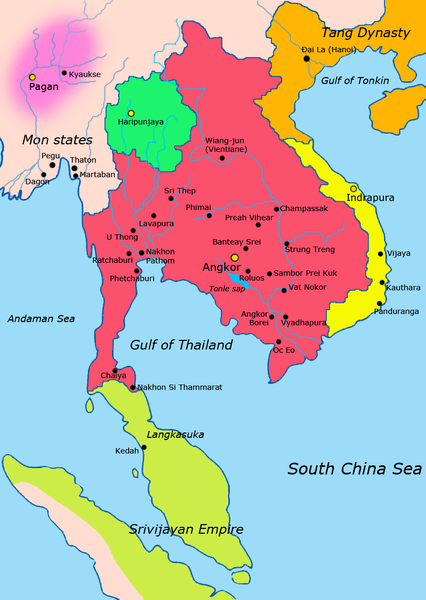
The shared food  by Thailand's northeast region and Laos could be explained by history. Modern-day Thailand and Laos were part of the Khmer empire (See above map from Wikipedia commons, Khmer Empire area labeled as red). When the monarchy fell in the 13th century, the Isan region became a part of the succeeding Lao Lan Xang kingdom for the next centuries, but in the 17th century, Siam stepped in and claimed the territory. From 18th to 19th century, Thailand "carried out forced population transfers from Laos to Isan (source)", followed by an extensive Thaification campaign, which encouraged the multi-cultural kingdom to adapt the script and culture of central Thailand. This led to a drift between the Lao of the Isan region and those in Laos, and Isan has since been a part of Thailand. But despite the established geographical boundary, Isan and Laos still share a culture and history that run deep. Their language and food, including sai ua, is a testament of this.

The good news with this realization is that, like in the Philippines, I can go around Laos and Northeast Thailand so sample a wide variety of sai ua! Once I do this, expect I'll share the experience here at Turo-turong Longganisa.


Saturday, August 13, 2011

Longanisa recipe: Sai ua

Here is a recipe of sai ua that I found online:


Sai Ua Moo
(Note: moo or mu means pork in Lao, so sai ua mo means pork sausage - ML)

Ingredients:
  • 400 grams pork meat, including some fat, washed and minced 150 grams pork fat, washed and minced
  • 2 dried chilli peppers, soaked in water until soft
  • 10 (small) shallots
  • 10 black peppercorns
  • pound the above three ingredients together finely
  • coriander leaves, finely chopped (Note: I was right! it does have coriander. :) - ML)
  • Salt and fish sauce
  • 1 pig's intestine, turned inside out and washed and then turned right side out again

Directions:
Place in a bowl the pounded ingredients, the minced pork, the minced pork fat and the chopped coriander leaves. Add the fish sauce and mix all together. Take a very small sample portion of the mixture, wrap it in pieces of banana leaf and grill it until cooked. Taste it and check the saltiness. (If this test is satisfactory you can proceed to make the sausages. If the taste of the grilled sample is not right, adjust the seasoning.)

Stuff a section of the pig's intestine with the mixture from the bowl, taking care not to include any air bubbles. If there are any, use a needle to let them escape.

Tie the intestine into portions as you stuff it, each portion to be 15 cm long. There should be two knots between each section with a space in between for cutting them apart. Use a bamboo holder to grill them until they are done. Then transfer them to a platter.

Serve with Jaew Bong.

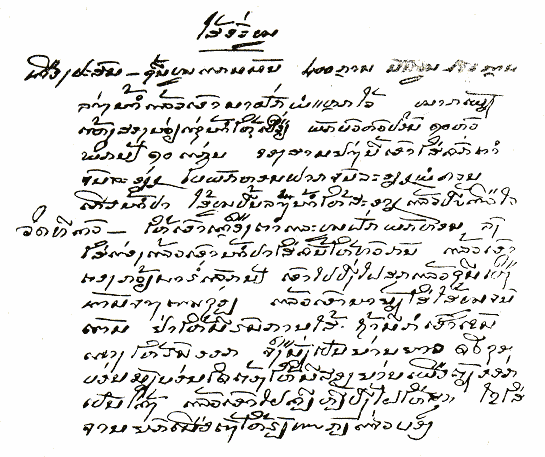
For those who can read it in script, here is the recipe:


Credit: The recipe and photo or recipe written in script is from http://www.seasite.niu.edu/lao/othertopics/foods/recipe12.htm. Many thanks for sharing the recipe with the world! :)

Saturday, August 6, 2011

And so the longganisa travel continues

Your source of longganisa travel accounts and trivia is back!

This old fascination has been revived as I continue my travels around the Philippines and the world in search of the best tasting longganisa.

For those who are clueless about longganisa, this is the spanish term for sausages. The Philippines, whose history bears 300 years of colonial rule under Spain, offers a variety of sausages; each having its own distinct taste which reflects the bounty of its source region or province. The love for longganisa has grown through through the centuries that it has become a staple in the breakfast table. Almost everywhere, you can find canteens, restaurants and fast food joints selling longsilog, which is short for longganisa-sinangag-itlog (or sausage, freid rice and fried egg).

Since an extensive and updated information source of longganisa around the Philippines has yet to be developed, I offer this humble site as a reference for your longganisa-related research and entertainment.

Every week, I will share with you new posts or updates which will hopefully satiate and further fuel your craving for longganisa.

Cheers,
Maia

Monday, August 13, 2007

Laoag longganisa: The world’s longest longganisa

Laoag City, Ilocos Norte

Laoag longganisa on Ilocos vinegar, cooked and cut

My longganisa travel begins in Laoag, a name that translates to light in Ilocano language, and for a very good reason, it'll shed light on my sausage appetite.

Where to find Laoag’s best
Days prior to my trip, I read in a review of some hungry traveler that the best longganisa is found right inside the public market — Aling Fe’s carinderia, where uncooked longganisa is sold and if you insist, Aling Fe can cook it for you for a fee.

So off to the market Lok and I went. The tricycle driver who took us from the plaza to the market told us that the best longganisa in Laoag is that of Johnny Julian’s, sold in one of the market’s meat stall.

No, we want it long
Laoag's Johnny Julian sausages
Two flights of stairs and a quick right later led us to Johnny Julian’s stall, which was manned by Nanay Edith and an assistant. To my disappointment, only familiar sausages hung on the hooks; Nanay Edith informed me that their long sausages sold out before noon and we arrived two hours late. I told her about my longganisa project and asked if they can cook their remaining sausages for us, Lok and I were starving. She said she can but we’d have to go to her two-storey home in Barangay 3.

A rewarding bite off Laoag’s “best” longganisa was extremely tempting, but our stomachs couldn’t wait any longer so I said no. Aw. I thanked Nanay Edith and bid her goodbye, then scanned the other meat stalls but no one was selling the thing that I badly wanted — really long longganisa.

Reluctantly, Lok and I left the market and walked to the next block, hoping to see a canteen selling longganisa. To our dismay, there was only Jollibee, banks and local stores of sort around the block. We decided to seek help from a local, the courteous driver who gladly took us around town, and stopped by at least four canteens. Sadly, they, like Johnny Julian’s, have sold out their longganisa. The driver wasn’t surprised. He explained that longganisa is sold only during mornings; the idea of all-day breakfast has yet to reach provinces at the tip of Luzon.

We weren’t lucky but I still had high hopes. Lok and I settled for lunch in a carienda past across the Laoag-Pagudpud terminal. We had dinengdeng, Ilocos’ version of pinakbet, igado and inihaw na liempo.

An hour later still at the carienda, Madi arrived. She flew in from Manila at Laoag International Airport, traveling for less than an hour compared to our half-day bus ride. Ugh.

While Madi was having lunch, I left for the market again, determined to find what I want before we leave for Pagudpud. This time around, I was lucky. At the far corner, there were two long longganisa hanging on a steel bar. I quickly made my way to the stall. This was my chance.

Laoag is world’s longest longganisa

Meet Aling Gloria. That’s Gloria Manuel of Felicing’s Cooked Meat, Stall #46 of Laoag’s public market.

Laoag's is the world's longest and best-tasting longganisa
Manang (Ate) Gloria has been making longganisa for more than a decade. Her family helps out in her business, making longganisa and manning their stall. She refused to say where or who taught her how to do it.

Manang Gloria proudly announces that Laoag has the world’s longest and best tasting longganisa. Last fiesta, the local government brought together with the longganisa manufacturers who made what would now be the Guiness-certified world’s longest longganisa.

She shares what she uses to make her longganisa:
• Grounded pork
• Ilocos garlic
• Ilocos vinegar
• Salt
• Pepper
• Vetsin


She refused to say how much of each goes into the long sausage. Her recipe, she insisted, is a secret and other longganisa makers wouldn’t give away their secret; they have their own suki.

Laoag longganisa: Choose between the two
Laoag longganisa comes in long or short tubes, both has the same taste. They say some favor long sausages while others, who sell them, like sausages of equal servings. One long longganisa can weigh as ¾ to 1 kilo. Uncooked, the sausage’s grounded meat looks pale brown inside a smoky, translucent pig intestine casing, which is cleaned and not dried. When cooked, it takes on a burnt brown color with a pungent and spicy aroma.

According to Manang Gloria, the Ilocos longganisa owes its distinct taste much to the Ilocos garlic and vinegar and rightly so, one can’t ignore the strong fusion of garlic and vinegar of cooked Laoag longganisa. The pungent scent later creates a foul mouth bomb after eating so be sure to have a mouthwash in hand.

Laoag longganisa is best eaten with rice and dipped in Ilocos vinegar with chopped garlic. But one can also eat it “kahit walang sawsawan kasi kumpleto na ang rekado,” adds Manang Gloria.

I bought 1 kilo of longganisa, that’s one really long longganisa and then some. I took it to Pagudpud and had it for dinner. In less than 15 minutes, Lok, Madi and I finished everything.

*****

LAOAG LONGGANISA:
Uncooked: Brown, long longganisa. One long longganisa which measures 24 to 30 inches, and weighs approximately ¾ kilo. Meat is stuffed into pig’s intestine, which isn’t sun-dried unlike Lucban longganisa. Its garlic and meat are chunkier than its Ilocos Sur counterpart.

Curled sausage
Cooked: Has burnt brown color and smells strongly of garlic and vinegar

Packaging: Newspaper. Longganisa curled in sheets of newspaper to prevent from smelling, then placed in a plastic bag.
Shelf life: The vinegar lets the sausage last up to five days in room temperature.

How to cook it:
Fried: Boil and let simmer until water dries up. Fry in its own oil or add oil as necessary.
Grilled: Grill like any meat.

Best eaten: Fried - dipped in Ilocos vinegar

Grilled - dipped in ketchup

Longganisa is the new adobo!

Longganisa’s varied tastes compare to that of our famous adobo

Longganisa
Sausage
casing stuffed with spicy meat: a tube of animal intestine or another tube-shaped casing stuffed with finely chopped pork or other meat

Microsoft® Encarta® 2006. © 1993-2005 Microsoft Corporation. All rights reserved.
[15th century. Via Old French saussiche < medieval Latin salsicius "made by salting" < Latin salsus, 14th century past participle of sallere “to salt”]
Microsoft® Encarta® 2006. © 1993-2005 Microsoft Corporation. All rights reserved.


If longganisa is chorizo and chorizo is a sausage, the root word of sausage suggests that chorizo is actually salted meat encased in animal intestine. Perhaps back in the 1600s, chorizo was made and preserved by salting alone. The Iberian sausage was introduced to Manila and later, to the other regions of the country. However, people in some regions may have lacked the necessary ingredients in making chorizo, and given the Filipinos ingenuity, they substituted it with the indigenous spices, altering the recipe and making it their own.

For instance, in the arid lands of Ilocos, only heat and dry-tolerant garlic and tobacco grow throughout the year. Rains are hard to come by in the northernmost tip of Luzon. Know for their frugality, Ilokanos make do with what they have — signature vinegar and garlic — and use it to make longganisa with that distinct tangy flavor with an aftertaste of vinegar.

In Luzon’s central plains, the land is more fertile and the sky, more forgiving. Here, rice is produced abundantly, earning the name the rice bowl of the Philippines. Where rice grows, the sugar can too and the Tagalogs use this sugar to add flavor to their local longganisa, the most famous being the Pampanga longganisa. Much of its success is owed to a family business which turned the sweet longganisa to a lucrative and almost-national business venture.

As for longganisa’s the other regions, I’ve yet to discover how the flavors came to be. I’ve a long way to go.

Longganisa primer

Longganisa in the Philippines traces its roots from the Spanish chorizo, the spicy Spanish pork sausage, introduced by the colonizers in the 16th century. The sausage, spicy chopped or ground meat stuffed in animal intestine or other tube casing, actually is indigenous/common in the Iberian Peninsula, in Spain and its neighbor Portugal.

Like everything introduced to the Filipinos, we accepted chorizo, changed it to suit our taste and took it as our own. What was once the spicy chorizo became sweet, salty and garlicky as well — in some regions, the taste was either one and in others, all at the same time. The Philippine longganisa too evolved through the years. Other meats were used new spices were introduced.
People favored certain tastes and they altered the recipe to suit their tastes. Philippine longganisa developed flavors as diverse and distinct as the adobo, with regions having their own specialty, among them are Vigan’s and Lucban’s garlic longganisa, Cebu’s sweet and spicy spherical longganisa, Nueva Ecija’s batutay and Imus’ adobo longganisa. It doesn’t come as a surprise, because the wide variety of longganisa reflects our multicultural and multilingual country.

My journey will take me across the country to have a taste of juicy and delectable longganisa and their culture. After all, with its its indigenous spices and ingredients, longganisa is more than treated meat -- it's a taste of culture stuffed in a small casing.

Friday, August 3, 2007

Ilocos prolouge

It's been a busy week and I haven't written my Vigan and Laoag entry, so these shall have to wait till Monday.

But as early as now, I want to thank

Nanay Ester of EJ's Vigan Longganisa
and
Nanay Gloria of Meat stall #34, Laoag City Market.


Photos of the trip and longganisa to follow!

Tuesday, July 10, 2007

Going around Pinas!

Nasaan ang pinakamasarap na longganisa?

Monday, July 9, 2007

From 12 variants to one

I’ve devoured more than 12 samples of longganisa when I created this blog. And by devoured, I mean I chomped on longganisa like the sausage glutton that I am. But for the sake of documenting reliving my longganisa dream, I have decided to start from square one.

So hello (and goodbye as I swallow you whole, eeek!) again: Longganisang Vigan, Baguio, Nueva Ecija, Pampanga, Tagalog, Lucban, Aklan, Cebu, Dumaguete and even CDO and other factory-manufactured longganisa available at supermarkets.

I’d be pitching in trivia and info tidbits on longganisa-making and –makers across the country, too. Heck, if I come across shocking, almost unbelievable or (the boring but) extremely useful information about sausage-making from other countries, I’ll post them here along with photos of my longganisa (mis)adventures.

Sausage starters

As a kid, I developed a constant craving for longganisa or native sausage. It was a house favorite, our weekly menu always had longganisa and too much of it, actually because there were days when I’d wake up to the smell of longganisa, take two of it to school for lunch and still find some left for dinner

But I loved longganisa most on Sunday afternoons, as I sit before the boob tube holding a plateful of chicken longganisa sliced sideways and steamy rice molded into spoonfuls. I’d pop in rice and a slice of longganisa as you do with chips, and I’d happily eat away without spoons away from my mother’s prying eyes (she said I might choke).

We had longganisa days during my elementary and high school years, and that created an appetite for it and a craving that lasted until adulthood. The craving gave birth to a dream and since I‘m now an adult capable of doing what I want, I decided to take this longganisa dream seriously; thus, the Longganisa Blog.

So read and relive my (mis)adventures! I swear I’ll make this blog longannisa’s most information-loaded, experiential, visual and interactive (somehow, we’ll get to exchange words about longganisa) online source.

-Maia